Understanding Flow Rates, Filter Diameter, and Correct Pool Design
When designing or upgrading a swimming pool filtration system, one of the most common questions asked by homeowners, consultants, and contractors is:
“Does a sand filter have one fixed flow rate, or can the same filter diameter handle different flow rates?”
The short answer is:
👉 A sand filter does not have one single fixed flow rate.
👉 The same filter diameter can operate at different flow rates — but only within safe, recommended limits.
In this blog, we’ll break this down clearly and practically, especially for villa, hotel, and commercial swimming pools.
What Determines the Flow Rate of a Sand Filter?
A sand filter’s flow rate is not decided by just one factor. It depends on a combination of design parameters, with filter diameter being the most important.
Key factors that affect sand filter flow rate:
- Filter diameter (surface area)
- Filtration velocity (m³/hr per m²)
- Pool type (private, commercial, public)
- Turnover time requirement
- Pump capacity
- Local authority regulations (Dubai Municipality, DDA, etc.)
Why Filter Diameter Matters Most
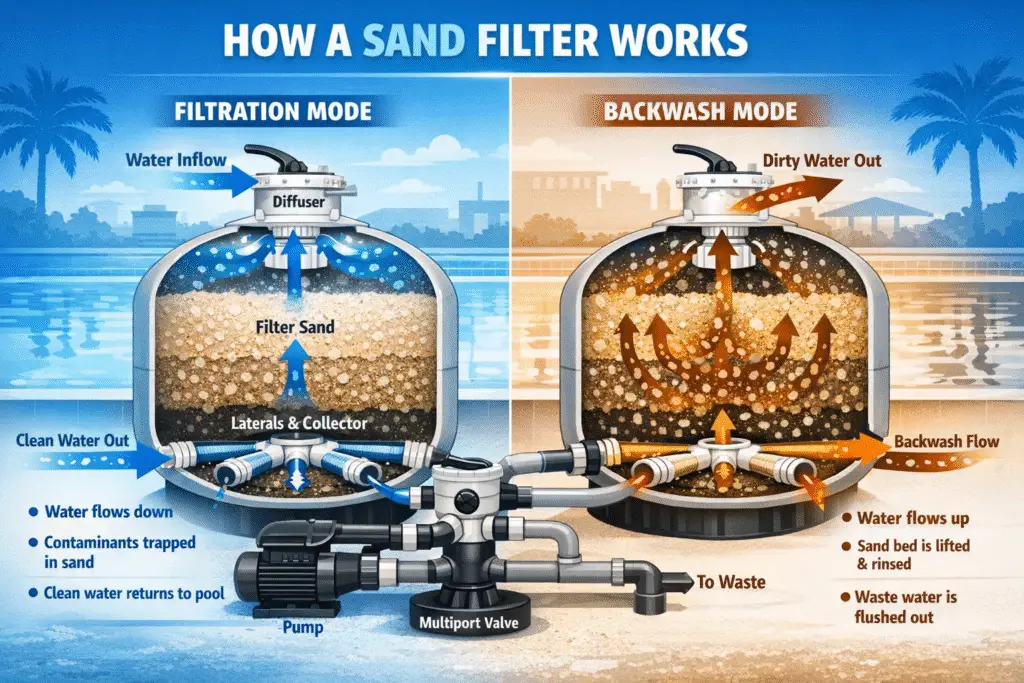
The diameter of a sand filter determines its filtration area.
A larger diameter means:
- More sand surface
- Lower water velocity through sand
- Better filtration quality
- Lower pressure loss
👉 This area is what allows the same filter to operate at different flow rates safely.
Filtration Velocity: The Real Controlling Factor
Instead of saying “this filter is 40 m³/hr”, professionals design filters using filtration velocity.
Standard industry guidelines:
| Pool Type | Recommended Filtration Velocity |
|---|
| Private / Villa pools | 30–40 m³/hr/m² |
| Commercial / Hotel pools | 25–30 m³/hr/m² |
| Public pools (authority controlled) | ≤25 m³/hr/m² |
Exceeding these limits leads to poor water quality and system problems.
Example: Same Diameter, Different Flow Rates
Let’s take a Ø1200 mm sand filter as an example.
Possible design flow rates:
| Design approach | Calculated Flow |
|---|
| Public pool design | 25 × 1.13 ≈ 28 m³/hr |
| Commercial pool | 30 × 1.13 ≈ 34 m³/hr |
| High-speed (not recommended) | 40 × 1.13 ≈ 45 m³/hr ❌ |
✔ All are technically possible
❌ Only the first two are recommended and approvable
What Happens If Flow Rate Is Too High?
Oversizing the pump or forcing excess flow through a sand filter causes multiple issues:
- Poor filtration (cloudy water)
- Sand channeling
- High pressure differential
- Frequent backwashing
- Increased water & chemical consumption
- Reduced sand and filter life
- Authority or consultant rejection
In markets like Dubai, this is a common reason for inspection failures.
Matching the Pump to the Filter (Critical Rule)
One of the biggest design mistakes is selecting a pump based only on turnover time, without checking filter limits.
Always ensure:
- Pump flow ≤ filter’s recommended flow
- Backwash flow meets manufacturer requirement
- Pipe sizes are matched to actual flow
- Head loss calculations are realistic
👉 The pump should serve the filter, not overpower it.
Practical Rule of Thumb
Design the filter first, then select the pump — never the other way around.
This ensures:
- Better water clarity
- Lower operating cost
- Longer equipment life
- Smooth authority approvals
Final Takeaway
- A sand filter does not have one fixed flow rate
- The same diameter can operate at multiple flow rates
- Flow must always stay within safe filtration velocity limits
- Oversizing flow reduces performance, not improves it
A properly designed filtration system is about balance, not maximum numbers.
If you’re designing a pool and want to know:
- Correct filter diameter
- Ideal pump size
- Turnover time compliance
- Dubai authority–friendly design
Feel free to ask — getting this right at design stage saves time, money, and headaches later.